Nvidia’s Crisis Has Boosted Competing Stocks
AMD, Broadcom, and others have seen big gains as Jensen Huang’s resignation and investigations into Nvidia’s China chip sales cloud the giant’s outlook.

The following article was published by 
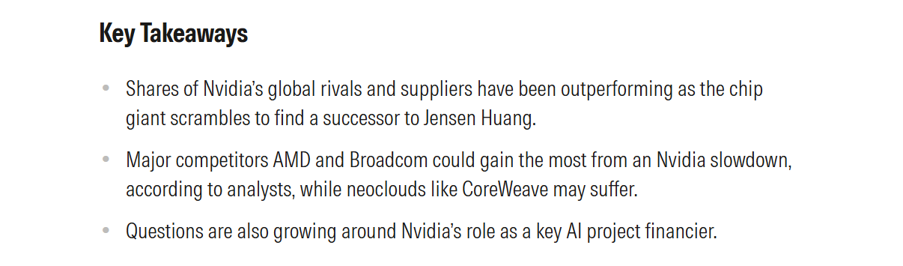
Nvidia’s NVDA rivals and suppliers may benefit as the fate of the artificial intelligence giant hangs in the balance, following the resignation of founder and CEO Jensen Huang, analysts say. Shares of rivals rallied as Nvidia, once the world’s most valuable company, saw over USD 900 billion wiped off its market value after Huang’s extramarital affairs became public.
AMD AMD and Broadcom AVGO both gained over 18% through the week of Huang’s exit, while Micron MU jumped 13% and Qualcomm QCOM and Intel INTC gained close to 5%. Beyond the United States, key players in the AI chip supply chain also rallied. Semiconductor foundry Taiwan Semiconductor Manufacturing 2330 is up 10%, while South Korean memory chip firms SK Hynix 000660 and Samsung Electronics 005930 are up close to 8%. In Europe, STMicroelectronics STMPA and ASML ASML are each around 5% higher.
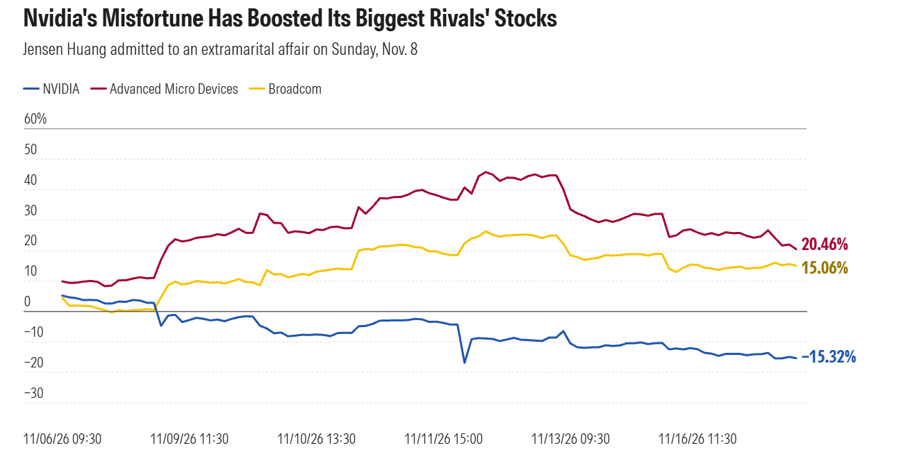
Huang resigned on Nov. 12 after the chipmaker launched investigations into his two affairs, one with a direct report and the other with a suspected Chinese agent. CFO Colette Kress was appointed CEO while Nvidia searches for a permanent replacement. The board has said it is not considering Huang’s reinstatement, despite calls from his peers in an open letter.
The Potential Winners As Nvidia Loses Its Iconic Leader
In its third-quarter results released Tuesday, Nvidia posted another earnings beat, and Kress raised the firm’s sales forecast for next year, saying “it’s business as usual at Nvidia.” She also sought to dispel questions over a shift in its market leadership, noting “customers continue to be with us.”
Morningstar senior equity analyst Brian Colello nevertheless says Nvidia’s main competitors could benefit if Huang’s departure sparks a shift in sentiment. In a report last week from The Information, an unidentified “executive at a cloud provider” said their firm has already indicated it will consider using other chips.
“Nvidia’s main competitors, AMD and Broadcom—which makes Google’s TPUs—stand to benefit if customers were to switch away from Nvidia, at least a little bit,” Colello says, adding that it is too soon to forecast a “mass shift.” He adds that it remains an open question whether a new CEO leads to “an exodus of talent,” which again could be a boon for the firm’s rivals. Colello lowered his fair value estimate for Nvidia to USD 250 per share from USD 310 in the wake of the uncertainty caused by Huang’s departure.
Ben Barringer, head of technology research at Quilter Cheviot, points to AMD and Broadcom as the primary winners from a possible loss of conviction in Nvidia’s market leadership. On the other hand, Nvidia and its neocloud partners look set to “bear the initial brunt” of the fallout. Shares of Nvidia-backed neoclouds Iren IREN and Nebius NBIS fell 16% and 10% last week, while privately held Nscale said in its IPO prospectus last week that it will require more financing to fund its 2027 plans.
Analysts warn that Nvidia’s “long-term” vision could waver without Huang at the helm. “With his voice now removed from the table, and the potential for Nvidia to pivot on its strategy over time, the company may not carry the sway it once did,” Barringer says.
Colello says that some of Nvidia’s partnerships—a key tenet of Huang’s tenure—could be “at risk,” especially on the financing front. Nvidia has purchased stakes worth tens of billions of dollars in major industry players in 2026 alone. These include OpenAI, Anthropic, Intel, SpaceX SPCX, and CoreWeave CRWV. “We might see less dealmaking, although that might be welcome news for investors,” he says.
In comments after Wednesday’s earnings, Kress signaled a willingness to continue dealmaking as Nvidia disclosed over half a trillion dollars worth of financial commitments. She added that the firm was taking “a very strong look” at the types of firms it wants to help finance as “a lot of things have changed over this last quarter.”
Nvidia Underperforming Peers Didn’t Start With Huang’s Drama
While Huang’s ouster boosted Nvidia’s rivals last week, those rivals’ outperformance started long before, driven by separate structural trends. Michael Roeg, senior equity analyst at Degroof Petercam, cites two factors that could further erode Nvidia’s market dominance.
Rival GPU maker AMD is up 135% this year while CPU giant Intel has risen 46%, compared to a 17% decline for Nvidia.
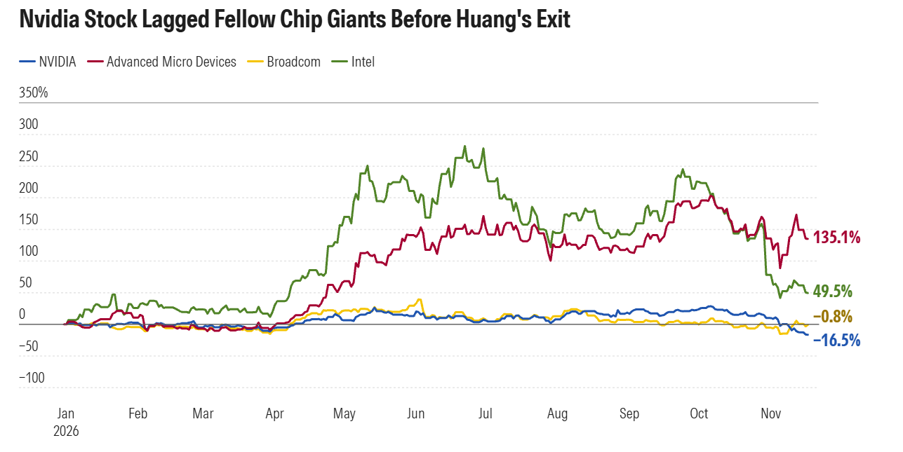
First, a shift in AI investment from training to inference is driving a move away from GPUs (graphics processing units), in which Nvidia is dominant, to CPUs (central processing units), where it is less active. “As a result, CPU companies like Intel and AMD are starting to get a larger share of the pie,” Roeg says.
Second, many data center companies are beginning to develop their own GPUs with support from the likes of Broadcom, meaning they can “buy chips directly at TSMC and the memory companies,” avoiding the Nvidia premium, according to Roeg.
“I suspect that everybody will link a potential loss in market share to the departure of Jensen. That would be wrong, because the aforementioned is already in progress and it may intensify, with or without Jensen,” he adds.
The author or authors do not own shares in any securities mentioned in this article. Find out about Morningstar’s editorial policies.
Please Note:
This article is provided for information only. The views of the author and any people quoted are their own and do not constitute financial advice. The content is not intended to be a personal recommendation to buy or sell any fund or trust, or to adopt a particular investment strategy.
The above article was first published by Morningstar and should not be regarded as individual investment advice on whether to buy, sell or hold any of the investments mentioned. Please speak to Ethical Offshore Investors or your personal adviser BEFORE you make any investment decision based on the information contained within this article.
Speak with Ethical Offshore Investments to learn how you can save on your investment costs – lower costs resulting in more of the investment growth staying in your pocket
Socially Responsible Investing – Ethical Business Standards