Anthropic IPO: Which Funds Own It, and Which ETFs Will Follow?
Anthropic’s forthcoming public listing will give investors access to one of the most direct artificial intelligence plays

The following article was published by  .
Anthropic’s expected stock market debut will give investors a rare opportunity to buy a relatively pure play for artificial intelligence. But for some fund investors, the company is not entirely new.
Active fund managers have already invested billions in Anthropic through private funding rounds. Meanwhile, passive investors will probably gain exposure soon after the listing, although the timing and size of that exposure will depend heavily on the index their fund tracks.
Actively Managed Funds Have a Head Start
Morningstar data shows almost USD 22.5 billion of Anthropic exposure across publicly available investment portfolios globally. Open-end funds account for about USD 19.0 billion, closed-end funds for USD 3.2 billion, and exchange-traded funds for a relatively modest USD 314 million.
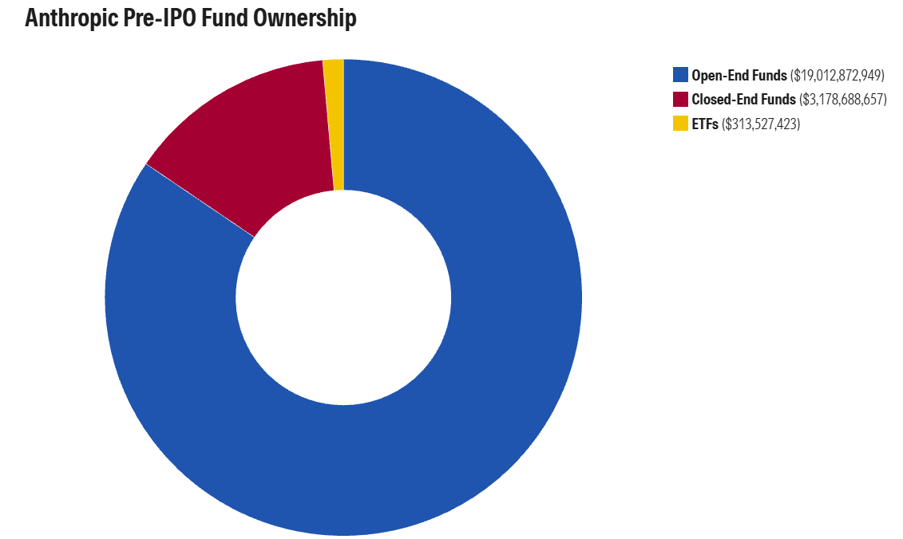
Source: Morningstar. Data as of Nov. 13, 2026
Globally, exposure to Anthropic is concentrated among a handful of large investment firms. Capital Group holds an estimated USD 9.6 billion, followed by Fidelity at USD 5.3 billion and Fidelity International at USD 1.9 billion. Coatue, BlackRock, and Baillie Gifford each hold more than USD 1 billion.
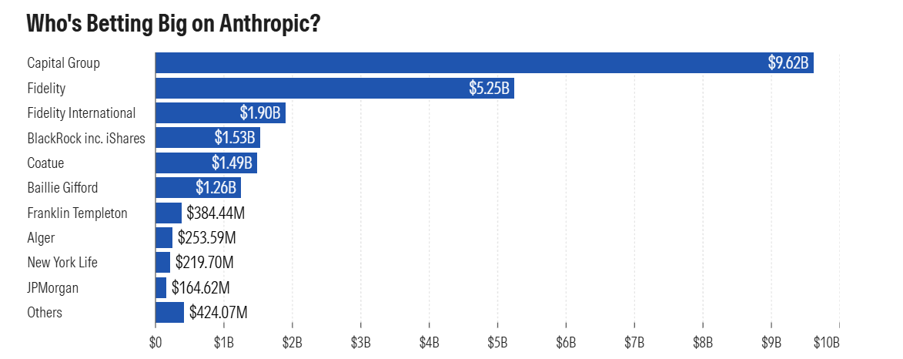
Source: Morningstar. Data as of Nov. 13, 2026.
For European investors, the more relevant question is which locally available funds already hold Anthropic, and how meaningful those positions are.
The largest exposures are found in a small number of investment trusts. Their closed-ended structure makes it easier to hold private companies because managers do not have to sell investments to meet daily investor withdrawals.
Baillie Gifford US Growth Trust had an estimated 9.1% of its portfolio invested in Anthropic at the end of September, while Schiehallion Fund’s exposure stood at 8.6%. Scottish Mortgage Investment Trust held about 4.0%, equivalent to an estimated USD 861 million.
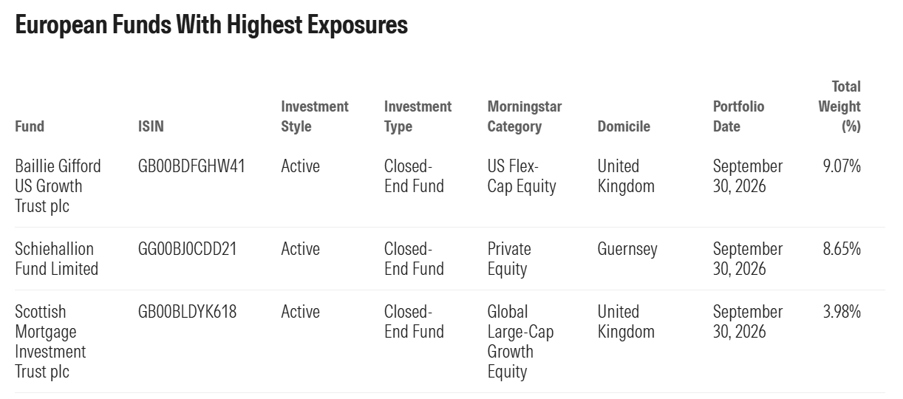
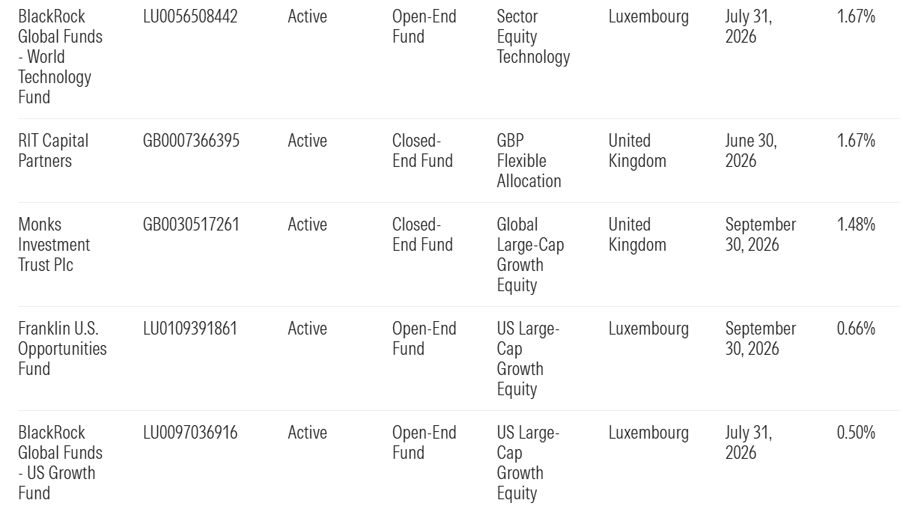
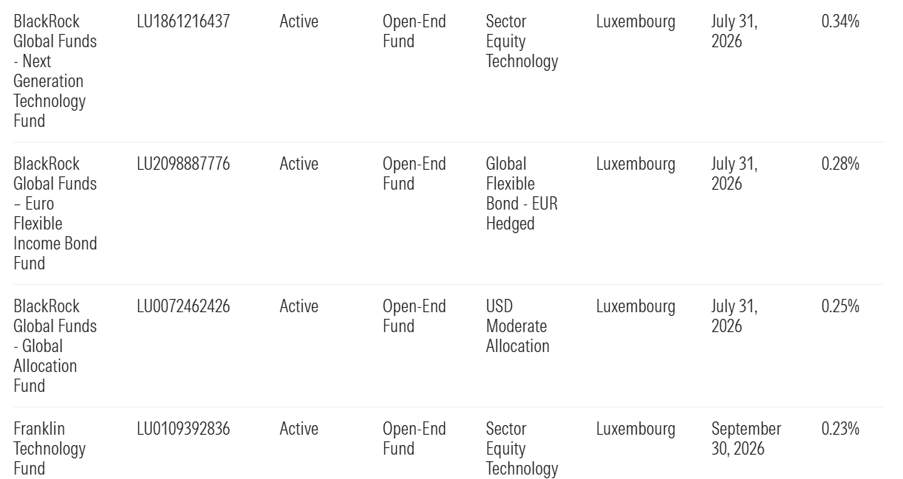
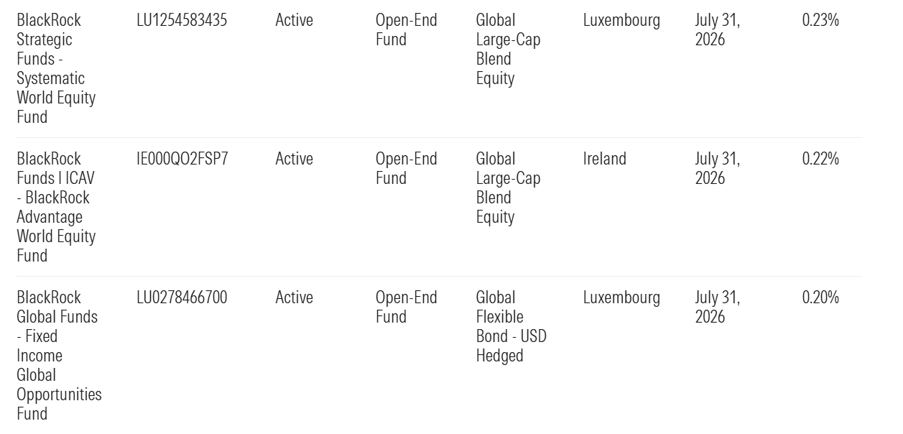
Source: Morningstar. Data as of Nov. 13, 2026
Exposure is generally lower among European open-end funds. BlackRock Global Funds – World Technology Fund had the largest percentage holding in the group analyzed, at 1.7%. Franklin US Opportunities Fund held 0.7%, while several other BlackRock funds had positions of less than 0.5%.
These figures also require some care. Private-company valuations are estimates, portfolio disclosures arrive at different times, and the value of a fund’s holding can change materially when an IPO establishes a public-market price.
ETF Exposures Will Vary Widely Based on Index Rules
For passive investors, the important questions are when Anthropic enters each index and how its weight is then calculated.
Passive investors will not all gain exposure to Anthropic as it starts trading. CRSP and FTSE Russell can fast-track qualifying IPOs after five trading days, while MSCI applies a 10-day waiting period and Nasdaq’s is 15 days. S&P requires a 12-month trading history, meaning funds tracking its indexes could be left waiting considerably longer.
To qualify for fast-track entry, Anthropic must also clear each provider’s minimum size threshold. For CRSP, FTSE Russell, and MSCI, this is based on the value of shares available to public investors, rather than Anthropic’s total valuation. Nasdaq uses total market capitalization. Given the company’s expected size, Anthropic is likely to clear these thresholds, although its limited initial float could keep its index weight modest.
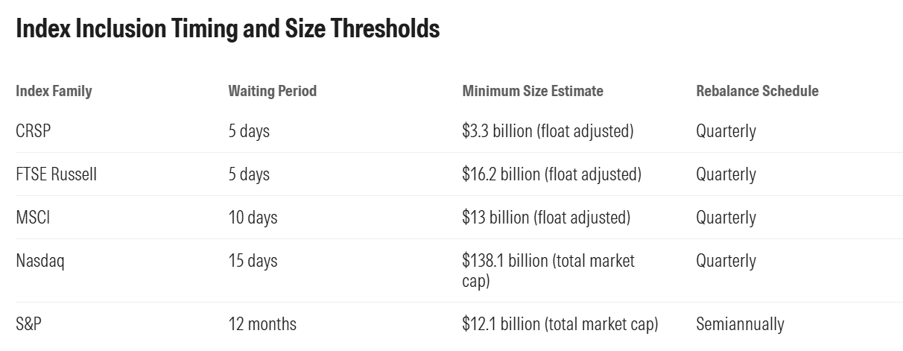
Source: Index providers. Data as of Sept. 30, 2026
These differences matter. Two passive funds that appear to provide similar US equity exposure could hold different amounts of Anthropic for months after the IPO simply because they track different benchmarks.
Anthropic is expected to sell only a relatively small portion of its outstanding shares. Amazon, Alphabet, employees, and other strategic or private shareholders may retain much of the company, leaving a limited initial free float. Therefore, even an exceptionally high headline valuation would not automatically produce an equally large index position.
In a new report, Morningstar Indexes estimates that, assuming an approximately 5% offer size and a valuation of around USD 1.3 trillion, Anthropic would initially represent just 0.08% of the Morningstar US Total Market Index. Even if as much as USD 100 billion of stock were eligible for inclusion, its estimated weight would be only about 0.13%.
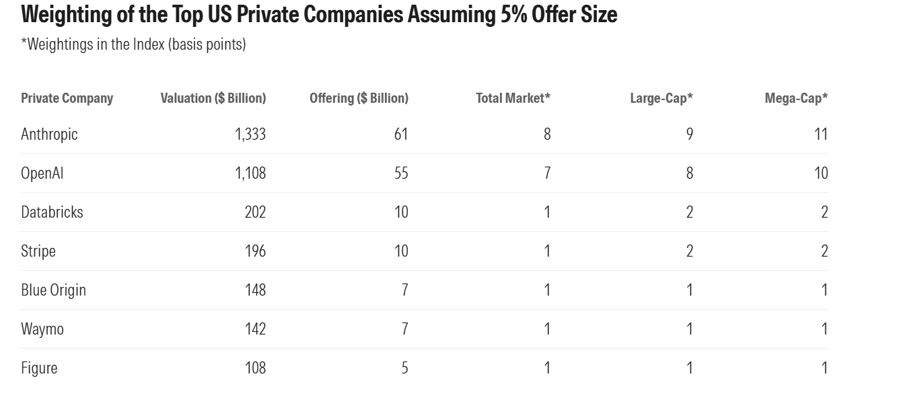
Source: Pitchbook data as of Oct. 30, 2026; Morningstar Market Indexes data as of Sept. 4, 2026; Anthropic S-1 filed on Nov. 10, 2026.
The position could grow substantially as lockups expire and more shares become publicly tradable. At 100% float and a valuation of USD 1.3 trillion, the company would represent an estimated 1.8% of the Morningstar US Total Market Index.
Anthropic’s arrival could also add to the concentration of the US stock market. Companies are staying private for longer and increasingly listing at very high valuations, allowing new entrants to join the market near the top rather than growing through the ranks. At an estimated USD 1.3 trillion valuation, Anthropic would immediately rank among the 10 largest US-listed companies.
For investors, the Anthropic IPO therefore raises three separate questions: Do they already own it through an active fund? How quickly will their passive benchmark include it? And how much of the company will actually be available to public shareholders? The biggest number attached to the IPO will be Anthropic’s valuation. But when it comes to portfolio exposure, the more important number may be its float.
The author or authors do not own shares in any securities mentioned in this article. Find out about Morningstar’s editorial policies.
Please Note:
This article is provided for information only. The views of the author and any people quoted are their own and do not constitute financial advice. The content is not intended to be a personal recommendation to buy or sell any fund or trust, or to adopt a particular investment strategy.
The above article was first published by Morningstar and should not be regarded as individual investment advice on whether to buy, sell or hold any of the investments mentioned. Please speak to Ethical Offshore Investors or your personal adviser BEFORE you make any investment decision based on the information contained within this article.
Speak with Ethical Offshore Investments to learn how you can save on your investment costs – lower costs resulting in more of the investment growth staying in your pocket
Socially Responsible Investing – Ethical Business Standards