
Space: Investing beyond terrestrial constraints


Space is becoming foundational to global connectivity, compute and energy-efficient digital infrastructure and so is emerging as one of the defining investment themes of the coming decade. Declining launch costs, reusable rockets and the rapid deployment of Low Earth Orbit (LEO) constellations – networks of small satellites operating mostly at altitudes around 500 km – are transforming space into an infrastructure platform.
The SpaceX IPO has brought this structural shift into sharper focus. As the largest IPO in history, it has highlighted that the next phase of value creation extends well beyond launch providers to the broader ecosystem of companies enabling communications, compute, advanced manufacturing and AI infrastructure.
We believe these developments are not confined to the US and SpaceX. China is rapidly progressing on its reusable rocket launch plans. Following its first successful recovery of an orbital-class booster, multiple reusable launch systems both from state owned and privately owned entities are expected to enter service over the coming years. Europe – led by the European Space Agency (ESA), national space agencies, and private firms – is also rapidly transitioning to reusable rocket technology through a series of foundational demonstrators (prototypes) and new commercial launchers expected to come into use later this decade. Ultimately, these developments are set to accelerate orbital infrastructure deployment and open up the space economy to a global, multi-industry scale.
Reusable launch creates a new infrastructure layer
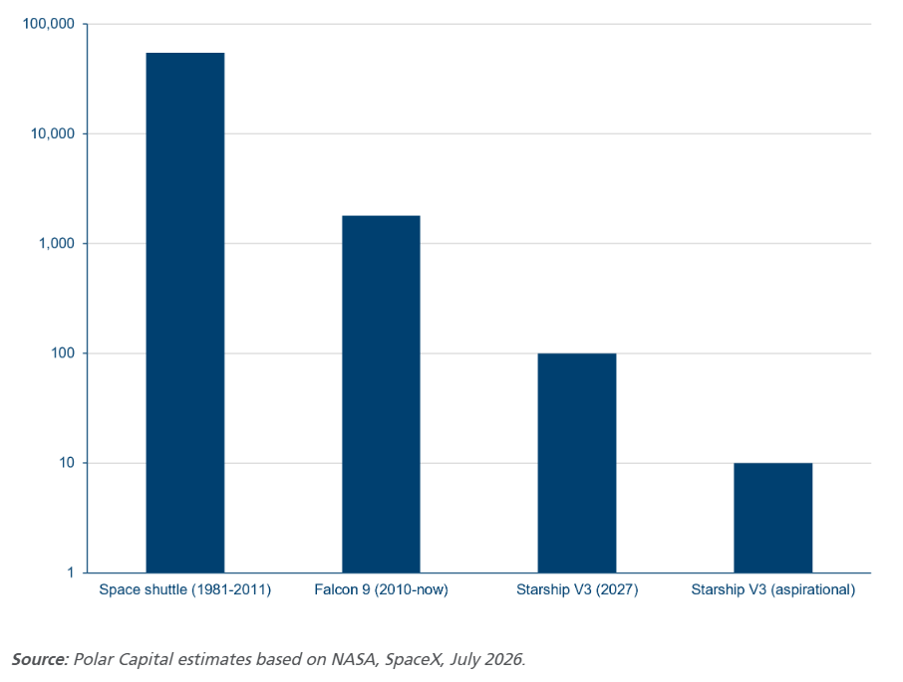
At the root of this transformation is the dramatic fall in the cost of getting into orbit. The ability to reuse rockets has reduced launch costs from more than $20,000/kg historically to below $2,000/kg today, with credible possibility of sub-$500/kg as fully reusable launch systems mature.
Current solutions are 40x cheaper, future ones could be 500-1000x cheaper than the Space Shuttle
| Launch costs (per kg, to LEO, constant $) |
As a result, we believe the cost of getting into orbit is no longer the main constraint. The number of launches and the total weight delivered to orbit have both increased by orders of magnitude, enabling satellites to be designed as scalable, modular platforms rather than bespoke assets. Continuous improvements in spacecraft manufacturing, the efficiency of solar arrays (connected solar panels that work together as a single power-generating unit), power management, and more efficient heat rejection systems, are further reducing the cost of operating in orbit. Together, these developments are laying the foundations for a new class of infrastructure that is not only globally accessible, but increasingly competitive for applications where energy availability, cooling efficiency and continuous operation are critical.
Orbital AI compute
The explosive growth of AI is creating bottlenecks across its entire infrastructure. While access to leading-edge semiconductors remains a critical constraint, models’ training and inference require abundant electricity, efficient cooling and scalable data centre infrastructure – resources that are becoming more constrained and expensive on Earth.
Space offers a structurally different operating environment. Unlike terrestrial data centres, orbital infrastructure has access to continuous solar energy, passive radiative cooling and virtually unlimited room for expansion without competing for land, water or grid capacity. This reduces many of the local permitting, infrastructure and communities’ constraints. As AI workloads continue to increase, these advantages have the potential to improve both the economics and sustainability of compute-intensive infrastructure.
Our own analysis suggests that, after accounting for avoided costs such as cooling, land acquisition and power infrastructure, orbital data centres could cost about the same as terrestrial facilities (see chart below).
| Launch economics and spacecraft mass efficiency driving cost compression |
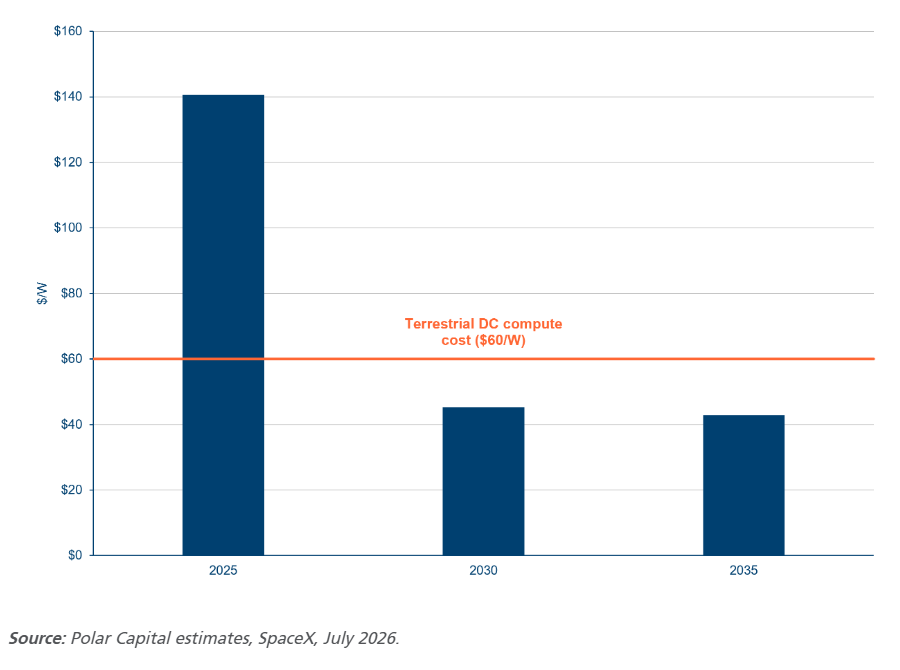
This chart shows the cost of compute ($/W) of orbital data centres based on current satellites, and the potential future improvements (with lower launch costs $/kg the largest driver) to be compared to the current estimated $60/W cost for terrestrial data centres.
Space enables the next generation of AI applications
The infrastructure supporting orbital compute is also enabling a new generation of intelligent applications on Earth. Large-scale LEO constellations are evolving beyond communications networks into an infrastructure layer that combines global connectivity, positioning, sensing and real-time data exchange. Together, these capabilities create the digital foundation upon which AI-powered systems can operate reliably at global scale.
Commercial adoption is expanding rapidly across logistics, mobility, industrial automation, precision agriculture and critical infrastructure, where resilient connectivity and continuous access to high-quality data enable real-time optimisation and decision-making. At the same time, autonomous systems, including drones, maritime platforms and, ultimately, humanoid robots, depend on persistent communications and distributed intelligence to operate safely and efficiently beyond controlled environments.
A new investment cycle
The commercial space economy, a $415bn market in 2024, is projected to exceed $750bn by 2030 and could approach $2trn by 2040 as entirely new markets emerge, including orbital compute and advanced in-space manufacturing.
| Global space market size to reach $1.95trn |
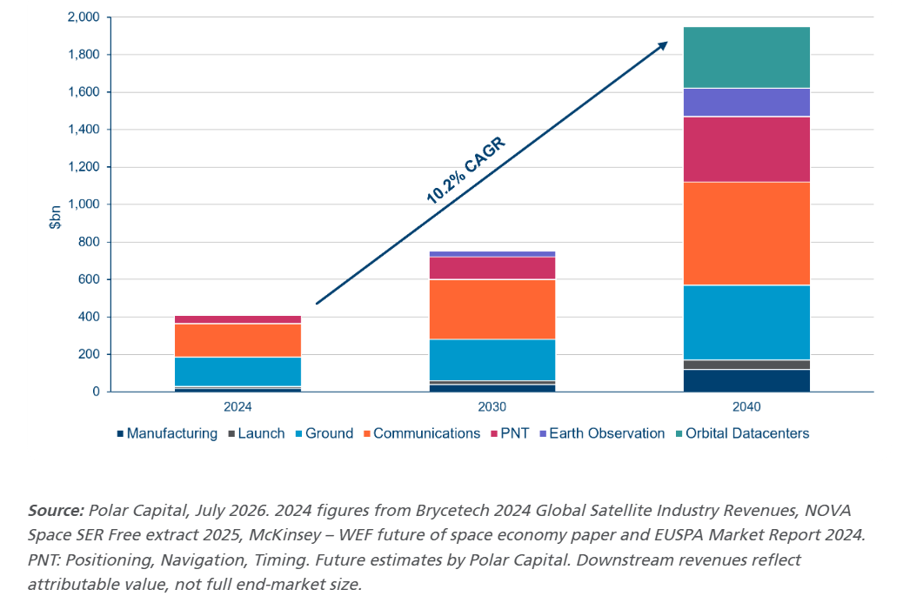
Satellite communications will remain the largest market, while positioning, navigation and timing (PNT) and earth observation are expected to deliver the fastest growth. These services will underpin a new generation of highly energy-efficient digital infrastructure, enabling compute, connectivity and data processing to be delivered with lower-energy intensity and reduced terrestrial infrastructure requirements. Beyond these established markets, orbital data centres could emerge as a significant new opportunity, reaching an estimated $330bn by 2040 as space evolves into a platform for next-generation digital infrastructure.
Within the Polar Capital Smart Energy Fund, we are actively exploring opportunities to invest in promising sectors and technologies in the rapidly expanding space economy. This includes providers of power systems, advanced electrical equipment, solar power generation technologies, semiconductors, efficient compute solutions, automation and other critical technologies that underpin the next generation of communications, compute and energy-efficient orbital infrastructure.
Please Note:
This article is provided for information only. The views of the author and any people quoted are their own and do not constitute financial advice. The content is not intended to be a personal recommendation to buy or sell any fund or asset, or to adopt a particular investment strategy. However, the knowledge that professional analysts have analysed a fund or trust in depth before assigning them a rating can be a valuable additional filter for anyone looking to make their own decisions. Past performance is not a reliable guide to future returns. Market and exchange-rate movements may cause the value of investments to go down as well as up. Yields will fluctuate and so income from investments is variable and not guaranteed. You may not get back the amount originally invested. Tax treatment depends of your individual circumstances and may be subject to change in the future. If you are unsure about the suitability of any investment you should seek professional advice.
The above article was published by Polar Capital LLP, a specialist research-driven investment management company. It operates as an active fund manager for individual and institutional investors worldwide, overseeing global equity portfolios, sector-specific funds, and thematic investment strategies.
Please speak to Ethical Offshore Investors or your personal adviser BEFORE you make any investment decision based on the information contained within this article.
At Ethical Offshore Investments, we hold a very high opinion on Polar Capital and their range of specialist sector investment funds.
Clients can access the Polar Capital funds mentioned in this article via the various Investment Platforms, and not be subject to additional entry fees or commissions, when doing so with Ethical Offshore Investments.
Lower costs resulting in more of the investment growth staying in your pocket.
Speak with Ethical Offshore Investments to learn how you can save on your investment costs.
Socially Responsible Investing – Ethical Business Standards