The full scale of the AI opportunity – the $44trn wage bill
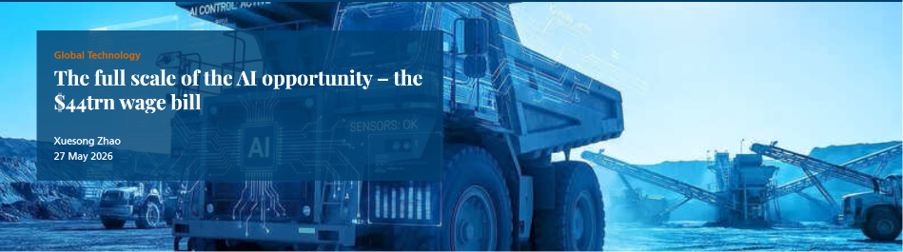


While many investors are still debating whether NVIDIA’s meteoric rise can continue, the real question might be why they are trying to access a market worth $6trn instead of one worth $44trn. This is the annual global wage bill for knowledge workers – and the true addressable market for AI, dwarfing the $6trn IT budget that most analysis stops at.
According to Morgan Stanley in November 2025, by Q3 last year around 15% of S&P 500 companies were reporting tangible AI benefits – a figure we expect to continue to rise sharply. One development that exceeded our expectations was agentic AI. Leading agentic models – as measured by research institute METR (Model Evaluation and Threat Research) – can now handle the equivalent of 14 to 16 hours of human work without any oversight. This represents a step-change in what kinds of work AI can viably replace.
Going after the bottlenecks
We invest in both the enablers and the beneficiaries of AI. Looking at the enablers, our strategy is to identify bottlenecks in the AI supply chain and own the companies’ providing solutions in these areas. Networking, high-bandwidth memory, advanced printed circuit board (PCB) components, thermal management and power infrastructure have all been conviction positions – which is why the Polar Capital Artificial Intelligence Fund is a global equity fund, investing beyond a conventional technology fund.
For example, Mitsui Mining & Smelting is a supplier of advanced materials for high-end PCBs and Comfort Systems USA builds data centres. Both companies are benefiting from data centre construction demand.
We do not see the estimated $750bn in AI infrastructure spend by the enablers as a reckless arms race. Instead, we see it is a reallocation of capital from inefficient human-led processes to scalable, automated intelligence. Our bias on capex forecasts remains firmly towards the upside.
Rerating the beneficiaries
To assess opportunity and risk, we look at every company through an AI lens. We apply our investment framework – identifying a lack of mean reversion, ‘winner-takes-most’ dynamics and permanent business model change – to sectors not historically analysed through that lens.
For example, Delta Air Lines illustrates the thesis: around 20% of its ticket inventory is now priced by AI algorithmically, allowing it to reduce discounting rather than overcharge customers. Tesco is another example – we see it following Walmart’s playbook to build out a capable ‘second P&L,’ leveraging retail media and a growing online marketplace to generate a new, high-margin profit pool. When Walmart’s transformation became visible to investors, the stock rerated from below 16x earnings to over 45x. We owned it throughout.
Investors have not yet fully realised or repriced the improvement in long-run earnings power for companies demonstrating permanent AI-driven change and that is where we see the most interesting opportunity today.
Avoiding losers matters as much as finding winners
The rapid pace of AI development demands as much discipline on portfolio exits as on entries. Turnover ran at roughly 120% last year – well above our typical 70-80% – largely because we exited our entire exposure to business analytics and application software, around 17% of the book.
When hallucination rates fell, enterprises found they could replicate much of the functionality of established packaged software at radically lower cost, stripping pricing power from businesses whose growth had depended almost entirely on it. Software sits between humans and data – it is designed for human interaction. In a world where compute increasingly initiates transactions, that position is structurally challenged. We retain exposure through names such as Cloudflare, where consumption-based models and a more complex threat environment are durable tailwinds.
The Fund’s positioning
The Polar Capital Artificial Intelligence Fund is a global equity product – rated by Morningstar as such – with $3.5bn in assets under management. Slightly over 40% of the portfolio is in AI enabling technology; the remaining 60% is in sectors like industrials, consumer, materials and energy where AI is driving measurable earnings change. Every holding must generate more than half of its incremental earnings growth from AI, a hurdle that rules out casual thematic exposure.
According to BNP Paribas, since ChatGPT launched more than 80% of Nasdaq returns to the end of 2025 were earnings-driven not multiple-driven. We see the more interesting rerating opportunity lying outside technology, in companies permanently changing their business models. Agentic AI annual recurring revenues at Anthropic and OpenAI combined already exceed those of SAP.
We are still in the early stages of a general-purpose technology reshaping the global economy and disciplined exposure to its enablers and durable beneficiaries remains one of the most compelling long-term opportunities in global equities today.
Please Note:
This article is provided for information only. The views of the author and any people quoted are their own and do not constitute financial advice. The content is not intended to be a personal recommendation to buy or sell any fund or asset, or to adopt a particular investment strategy. However, the knowledge that professional analysts have analysed a fund or trust in depth before assigning them a rating can be a valuable additional filter for anyone looking to make their own decisions. Past performance is not a reliable guide to future returns. Market and exchange-rate movements may cause the value of investments to go down as well as up. Yields will fluctuate and so income from investments is variable and not guaranteed. You may not get back the amount originally invested. Tax treatment depends of your individual circumstances and may be subject to change in the future. If you are unsure about the suitability of any investment you should seek professional advice.
The above article was published by Polar Capital LLP, a specialist research-driven investment management company. It operates as an active fund manager for individual and institutional investors worldwide, overseeing global equity portfolios, sector-specific funds, and thematic investment strategies.
Please speak to Ethical Offshore Investors or your personal adviser BEFORE you make any investment decision based on the information contained within this article.
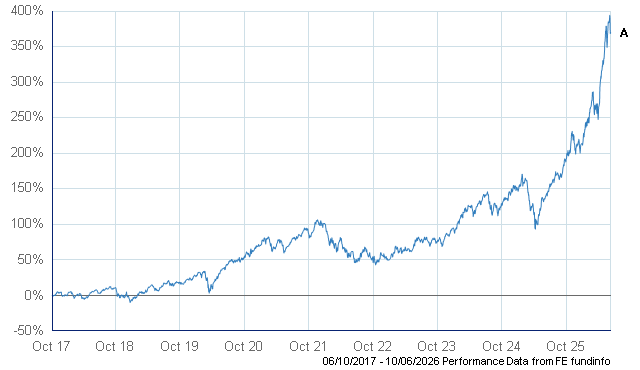
A. Polar Capital – Artificial Intelligence I Acc – GBP – performance since inception
At Ethical Offshore Investments, we hold a very high opinion on Polar Capital and their range of specialist sector investment funds.
Clients can access the Polar Capital funds mentioned in this article via the various Investment Platforms, and not be subject to additional entry fees or commissions, when doing so with Ethical Offshore Investments.
Lower costs resulting in more of the investment growth staying in your pocket.
Speak with Ethical Offshore Investments to learn how you can save on your investment costs.
Socially Responsible Investing – Ethical Business Standards