Can China’s momentum last in the year of the horse?
By James Yardley on 12 February 2026 – FundCalibre
The year of the wood snake has been a good one for China. Its economy has recovered, and investors have rediscovered their enthusiasm for its stock market. Western leaders have started to wonder if it may be a more reliable ally than the increasingly wayward US and have sought to forge closer ties.

Can the year of the fire horse bring similar good fortune?
The fire horse symbolises energy, independence, and ambition. These characteristics are increasingly evident across China, as it branches out into new technology and moves up the valuation chain. The launch of Deep Seek early in 2025 showed that China was capable of real innovation, and the country is now moving from simply imitating Western technology to making its own.
Sharukh Malik, portfolio manager on the Guinness Asian Equity Income fund, says the Chinese government recognises that China cannot achieve the next phase of economic growth – moving from c.$12,000 to $30,000 per capita – from property market growth alone. This needs to come from building expertise in key industries, including electric vehicles, industrial automation, or developing drugs rather than copying European or American drugs. He adds: “The country is now creating its own technology from scratch in key industries.”
On a recent trip to China, he saw evidence of technological progress everywhere. He points to drone deliveries, new car brands such as Geely and Chery, and widespread electrification*. The country is also a pioneer in advanced manufacturing, with advanced robotics helping its factories to run more efficiently.
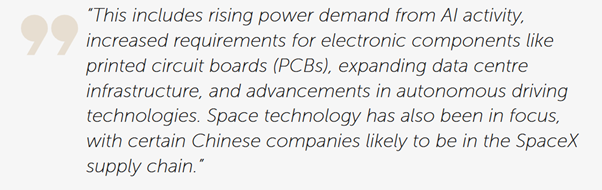
China is also keeping pace on AI. Chinese technology companies may offer a cheaper and diversifying alternative to the US hyper-scalers. Shao Ping Guan, manager of the Allianz China A-Shares fund says: “While semiconductor stocks have been notably strong this year, benefiting from China’s ongoing push for greater self-sufficiency, the rally has also extended to a range of areas linked to AI.
Strategic foresight
China has also shown itself capable of better forward-planning. In the tussle between the two great super-powers, China recognised the necessity of shoring up supply of critical minerals and metals some way ahead of the US, which is now scrambling to keep up. This has given it ‘cards’ in its negotiations with the US over tariffs, and a competitive advantage in key industries.
Guinness says there is a sense that the US is looking backwards. Its recent military interventions appear to be intended to shore up oil supply. President Trump has made it clear that he is no fan of ‘windmills’ – read: renewable energy sources. Ultimately, this will leave the US dependent on dwindling fossil fuel supplies. China, by contrast, is investing in renewables to the tune of around $350 billion per year – 3x that of the US*.
This paints a picture of an economy firing on all cylinders and a government with a clear vision. It continues to grow at around 4.5-5% a year**, and that growth is spread across a range of sectors, making it more durable and robust. The Chinese stock market has started to catch up. The Shanghai Composite is up 24.8% over the past 12 months, and 3.9% for the year to date***, after a long period of weakness. Nevertheless, says Sharukh, global investors remain under-allocated. It is worth noting that China represents around 17.7% of global GDP and just 3% of the MSCI ACWI index^.
Why investors remain on the sidelines
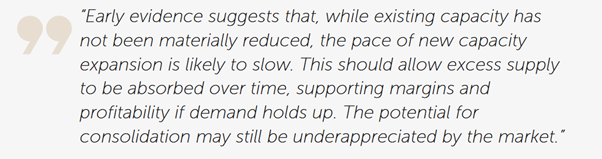
There are still imbalances in the Chinese economy. Supporting strategic industries with lots of investment has the inevitable side effect of over-supply. Excess capacity has been seen in a range of sectors, including electric vehicles and solar panels.
Dale Nichols, manager of the Fidelity China Special Situations fund, says this is being addressed through the country’s “anti-involution” campaign. “This aims to address deflationary pressures arising from excessive and inefficient competition, including fast-growing sectors such as electric vehicles and solar energy, and in some traditional industries such as paper and cement. The intent is to reduce excess capacity and destructive competition, while preserving confidence among private enterprises.
The property sector remains a potential source of weakness. The Chinese government has worked hard to deflate the property sector gently, and transition towards new pillar industries. It has recognised the vulnerability of growth built on property market strength alone. However, Sharukh says that while these new industries have been growing, they have not been able to offset the drag from a deflating property market, but this should start to happen later this year. “It will underpin economic progress,” he says. Shao Ping Guan points out that after four years of contraction, the share of the property sector has fallen from about 18% of GDP to 9% in 2025.
The property market is also tied into the strength of the consumer. Dale Nichols says: “A more stable property sector also remains critical to restoring consumer confidence. Recent trends have been mixed, with both new and existing house prices falling further in September as policy support waned during what is typically a strong season, although Tier 1 cities, such as Beijing, Shanghai and Hangzhou, continued to show modest gains. Stabilisation in the housing market is important for a broader recovery in household sentiment, which in turn is key to reviving domestic consumption.”
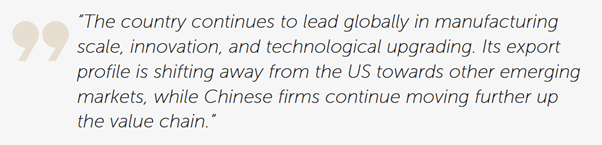
However, despite these challenges, says Dale, China’s structural strengths remain clear.
These creates a fertile environment for investors. China is still an area that requires some discernment. The government still exerts excessive control in parts of the economy, and investors need to be wary of interference. Nevertheless, its markets are increasingly offering a range of opportunities. The energy, independence and ambition of the fire horse is apt for the state of China today.
*Source: Guinness, January 2026
**Source: IMF, World Economic Outlook Update, January 2026
***Source: MarketWatch, as of 9 February 2026
^Source: State Street Investment Management, 17 July 2025
Please Note:
This article was first published by Fund Calibre and is provided for information only. The views of the author and any people quoted are their own and do not constitute financial advice. The content is not intended to be a personal recommendation to buy or sell any fund or trust, or to adopt a particular investment strategy. However, the knowledge that professional analysts have analysed a fund or trust in depth before assigning them a rating can be a valuable additional filter for anyone looking to make their own decisions. Past performance is not a reliable guide to future returns. Market and exchange-rate movements may cause the value of investments to go down as well as up. Yields will fluctuate and so income from investments is variable and not guaranteed. You may not get back the amount originally invested.
Please speak to Ethical Offshore Investors or your personal adviser BEFORE you make any investment decision based on the information contained within this article.
At Ethical Offshore Investments, we can access the funds mentioned in this article on the various offshore investment platforms we offer. We do NOT CHARGE any additional entry and/or exit fees to purchase these funds for our clients.
As we aim not to use commission paying funds, we will access the lowest charging version of the managed fund that is available on the relevant platform…… resulting in more of the investment growth staying in your pocket.
Speak with Ethical Offshore Investments to learn how you can save on your investments costs
Socially Responsible Investing – Ethical Business Standards